
Alexandria feels different from the rest of Egypt. Sea breezes replace desert heat, the skyline curves along a long waterfront, and the streets hold traces of Greek, Roman, Islamic, and European history layered on top of one another. Founded more than 2,300 years ago, this port city was once the intellectual capital of the ancient world. Today it is a relaxed, atmospheric destination with cafes, seafood, historic sites, and a salty, nostalgic charm that’s hard to find anywhere else in Egypt.
A Brief History of Alexandria
Alexander the Great founded the city in 331 BCE, and after his death it became the capital of the Ptolemaic dynasty, the Greek-Macedonian rulers who governed Egypt for nearly 300 years. Under the Ptolemies, Alexandria became a global center of trade, science, and learning. It was home to the Great Library, one of the largest collections of knowledge in the ancient world, and to the Pharos, a towering lighthouse counted among the Seven Wonders of the Ancient World.
It was also the city of Cleopatra VII, the last active pharaoh, whose reign ended when Egypt became a Roman province in 30 BCE. Over the centuries Alexandria passed through Roman, Byzantine, Arab, Ottoman, and modern European influence, and in the 19th and early 20th centuries it became a cosmopolitan hub where Greeks, Italians, Jews, Armenians, and Egyptians lived side by side. That mixed heritage still shapes its architecture, food, and literature.
Top Things to See in Alexandria
1. Bibliotheca Alexandrina
The modern library, opened in 2002, was built to honor the spirit of the ancient Great Library. Its giant tilted-disc roof, carved with letters and symbols from many scripts, faces the Mediterranean. Inside you’ll find huge reading halls, museums, galleries, and exhibitions on science and culture.
Tip: Even if you’re not a reader, the architecture and waterfront setting make it worth a visit. Check current visiting rules and which sections are open.
2. Qaitbay Citadel
This 15th-century fortress stands at the tip of the eastern harbor, built by the Mamluk sultan Qaitbay around 1477. It sits on or near the spot where the ancient Pharos lighthouse once stood, and some of the lighthouse’s stones were reused in its construction. Climb the ramparts for sea views and a sense of how the city defended its harbor.
Tip: Go late in the afternoon for softer light, and walk along the nearby seafront.
3. Catacombs of Kom el-Shoqafa
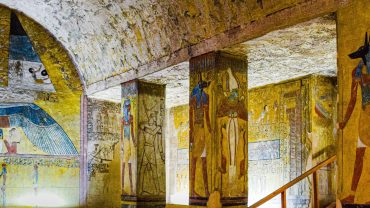
Dating to the 2nd century CE, these Roman-era tombs are among the largest burial sites of their kind in Egypt. They are famous for blending Egyptian, Greek, and Roman styles, so you’ll see gods like Anubis dressed as Roman soldiers. The tombs spiral down through several levels around a central shaft.
Tip: The stairways are narrow and can be humid, so wear sturdy shoes.
4. Pompey’s Pillar and the Serapeum
This tall red granite column is one of the most recognizable monuments in Alexandria. Despite its name, it was erected in honor of the Roman emperor Diocletian around 297 CE. It stands over the site of the Serapeum, a major temple to the god Serapis, and you can still explore underground galleries and sphinx statues around it.
5. Kom el-Dikka Roman Amphitheatre
In the middle of the city, this small, well-preserved Roman theater with marble seating is a reminder of Alexandria’s ancient urban life. Nearby are the remains of Roman villas and baths, and the site is easy to combine with other downtown sights.
6. Alexandria National Museum and Greco-Roman Museum
The Alexandria National Museum is housed in a beautifully restored mansion and presents artifacts covering Pharaonic, Greek, Roman, Coptic, and Islamic periods. The Greco-Roman Museum focuses on the Hellenistic and Roman eras. Together they show how the city’s past unfolded, so check which are currently open before you plan.
7. Montaza Palace and Gardens
On the eastern edge of the city, the Montaza estate was once a royal retreat of Egypt’s ruling family. Its palace is mostly viewed from outside, but the extensive gardens, palms, and beaches make a pleasant escape. It’s a good place for a picnic or a quiet walk by the sea.
8. Abu al-Abbas al-Mursi Mosque
One of the city’s most beautiful mosques, it features elegant domes, arches, and a tall minaret near the Eastern Harbor. It is an active place of worship, so dress modestly and be respectful of prayer times.
9. The Corniche
The Corniche is Alexandria’s long seafront promenade, running for kilometers along the Mediterranean. Locals walk it in the evening, fish from its rocks, and sit in cafes with a view of the water. Sunset here is a local ritual.
Alexandria’s Underwater Heritage
Much of ancient Alexandria now lies beneath the sea, submerged by earthquakes and rising waters. Underwater archaeologists have found statues, columns, and blocks believed to be from the royal quarter and the Pharos area. Nearby in Abu Qir Bay, teams have also explored the sunken cities of Heracleion (Thonis) and Canopus, where temples, colossal statues, and ancient ships have been recovered.
Some of these finds are displayed in Egyptian museums, and diving access has been discussed over the years. If this interests you, check current rules and licensed operators, since access is limited and regulated.
Food and Cafes in Alexandria
Alexandria is a food lover’s city, especially for seafood.
Fresh fish and shellfish: Many restaurants let you choose your fish from the catch and have it grilled, fried, or baked with local spices.
Alexandrian specialties: Look for spiced Alexandrian-style liver, hawawshi (spiced meat baked in bread), and shrimp dishes cooked in clay pots.
Street food and sweets: Try fresh ful and ta’ameya for breakfast and local pastries from old bakeries.
Cafe culture: The city has a long tradition of grand old coffee houses, where you can linger over Turkish coffee, tea, and conversation. Many visitors also enjoy ice cream by the sea, a local favorite.
Literary Alexandria
The city has inspired generations of writers. The poet C. P. Cavafy lived here for most of his life, and Lawrence Durrell set his Alexandria Quartet in the city’s mixed society. Literary fans can look for old cafes, bookshops, and the Cavafy museum, which is housed in his former home. Check whether it’s open before you go.
Best Time to Visit
Alexandria has a Mediterranean climate. Spring (March to May) and autumn (September to November) are pleasant for sightseeing. Summers are warm and humid but busy with Egyptian holidaymakers heading to the beaches, while winters can be windy, cool, and rainy, bringing a moody, atmospheric feel. Pack a light jacket for the cooler months.
How to Get to Alexandria
By train: Trains run regularly between Cairo and Alexandria, and are a popular, scenic option. Check current classes, schedules, and booking methods.
By road: Buses and private cars link Alexandria with Cairo, typically taking a few hours depending on traffic.
By air: Alexandria has airports with some domestic and international connections.
Day trip or overnight: Many travelers visit from Cairo for a day, but staying one or two nights lets you enjoy the evenings by the sea.
Suggested Itineraries
One day: Qaitbay Citadel, Bibliotheca Alexandrina, a seafood lunch, Kom el-Shoqafa and Pompey’s Pillar, and sunset on the Corniche.
Two days: Add the museums, Kom el-Dikka, Abu al-Abbas Mosque, and Montaza Gardens, plus time in the old cafes.
Three days: Add a beach day, literary sites, or a trip along the coast, and slow down.
Practical Tips
Dress modestly for mosques and religious sites, and cover shoulders and knees.
Carry some small change for tips and small purchases, and agree taxi prices in advance or use trusted ride-hailing apps.
Wear comfortable shoes, since the catacombs and archaeological sites involve stairs and uneven ground.
Bring a light layer, as sea breezes can feel cool in the evening.
Confirm current opening hours, ticket prices, and which museums are open, as they change.
Final Thoughts
Alexandria is a city of memory, where the ancient world, the Mediterranean, and modern Egypt meet. Its monuments are less grand than Giza or Luxor, but its charm lies in the combination of history, sea air, food, and slow evenings by the water. If you want to see another side of Egypt, spend a few days here and let the city unfold at its own pace.
Explore exciting tours and unforgettable Red Sea adventures.
View Tours & Excursions →
Find your dream property by the Red Sea with flexible installments.
Explore Properties →
Comment (0)