
Most first-time visitors to Egypt see the Pyramids of Giza and the Cairo museums, and those are well worth the trip. But the country is far bigger and more varied than its capital. Beyond Cairo you’ll find coral reefs full of life, silent white deserts, riverside Nubian villages, and a Mediterranean city with ancient roots. Here are ten places that show a different side of Egypt.
1. Luxor: The World’s Greatest Open-Air Museum
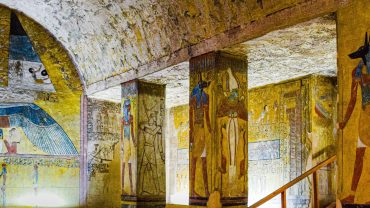
Luxor, ancient Thebes, holds a huge share of Egypt’s monuments in a single city. On the east bank are Karnak and Luxor Temple, and on the west bank are the Valley of the Kings, the Temple of Hatshepsut, and the Colossi of Memnon. You could spend a week here and still not see everything.
Best for: temples, tombs, and ancient history.
Tip: Plan for at least three days, and consider a sunrise hot-air balloon flight over the West Bank.
2. Aswan and the Nubian Villages
Aswan is a gentler, slower city where the Nile runs between granite boulders and golden dunes. Take a traditional felucca sailboat around Elephantine Island, visit the Temple of Philae on its island, and see the Unfinished Obelisk in the ancient granite quarries.
The real highlight for many travelers is the Nubian villages nearby, with colorful houses, warm hospitality, and a culture distinct from the rest of Egypt. Aswan is also the base for visiting Abu Simbel, which is a long journey south.
Best for: relaxing river scenes, Nubian culture, and food.
Tip: Try a Nubian home-cooked meal and tea on the riverbank.
3. Alexandria: Egypt’s Mediterranean Pearl
Founded by Alexander the Great in 331 BCE, Alexandria was once home to the legendary Lighthouse of Alexandria and a great library. Today it is a breezy seaside city with faded grandeur, cafes, and fresh seafood. Top sights include:
Bibliotheca Alexandrina, a striking modern library inspired by the ancient one.
Qaitbay Citadel, a 15th-century fortress built on the site of the ancient Pharos lighthouse.
Catacombs of Kom el-Shoqafa, a Roman-era tomb mixing Egyptian, Greek, and Roman styles.
The Corniche, the long waterfront promenade perfect for evening walks.
Best for: history lovers, seafood, and a cooler break from the desert.
Tip: Visit outside the hottest summer months and leave time for the cafes.
4. Siwa Oasis: A Hidden Desert Escape
Siwa lies deep in the Western Desert near the Libyan border, a green island of palms, salt lakes, and mud-brick buildings. It has its own Amazigh (Berber) culture and language. The oasis is known for:
The ruins of the Temple of the Oracle of Amun, which Alexander the Great is said to have visited.
The mud-brick Shali Fortress at the heart of the old town.
Salt lakes where you can float effortlessly.
Natural springs, sand dunes, and date and olive groves.
Best for: quiet nature, stargazing, and a slow pace.
Tip: Rent a bicycle to explore the oasis, and try the local dates and olive products.
5. The White Desert and Black Desert
Near Bahariya and Farafra, the White Desert National Park looks like another planet. Wind has sculpted chalk rock into giant mushrooms, towers, and animal-like shapes that glow pink and gold at sunset. Nearby, the Black Desert is covered in dark volcanic hills, and the Crystal Mountain is made of sparkling quartz.
Most visitors take a 4×4 safari and spend a night camping among the formations, under an extraordinary sky.
Best for: camping, photography, and stargazing.
Tip: Book with a licensed operator, bring warm layers for the cold desert nights, and check permit rules before you go.
6. Hurghada and the Red Sea Coast
Hurghada is the Red Sea’s best-known resort hub, with long beaches, sunny weather almost year-round, and easy access to world-class snorkeling and diving. Boat trips run to the Giftun Islands, where you can swim above colorful coral gardens, and the area is popular for kitesurfing, windsurfing, and desert quad tours.
Best for: beaches, snorkeling, diving, and winter sun.
Tip: Choose boat operators that follow reef-protection rules, and use reef-safe sunscreen.
7. Marsa Alam: Reefs, Turtles, and Dugongs
South of Hurghada, Marsa Alam is quieter and wilder, with some of Egypt’s healthiest reefs. At spots like Abu Dabbab you can snorkel with green sea turtles and, if you’re lucky, see a dugong grazing on seagrass. Divers head for offshore sites such as Elphinstone Reef, which is best for experienced divers because of currents.
Inland, the Wadi el-Gemal National Park mixes desert, mangroves, and coast.
Best for: marine life, eco-resorts, and peaceful beaches.
Tip: Go in the early morning for the best chance of seeing turtles and fewer crowds.
8. Dahab: The Laid-Back Sinai Beach Town
Dahab sits on the Gulf of Aqaba in South Sinai, a relaxed seaside town with a bohemian feel, Bedouin influences, and a mountain backdrop. It is a favorite for freediving, windsurfing, and kitesurfing, and the shore reef is great for snorkeling right off the beach.
The famous Blue Hole is a spectacular dive site, but it is also dangerous for inexperienced or untrained divers, so dive only with qualified professionals and stay within your training limits.
Best for: water sports, yoga, backpackers, and slow days by the sea.
Tip: Walk the waterfront at sunset and try a seafront Bedouin-style dinner.
9. Mount Sinai and Saint Catherine’s Monastery
In the rugged mountains of South Sinai stands Saint Catherine’s Monastery, one of the oldest continuously inhabited Christian monasteries in the world, founded in the 6th century. It is a UNESCO World Heritage Site, holding rare manuscripts and icons.
Above it rises Mount Sinai (Jebel Musa), revered in Jewish, Christian, and Islamic tradition as the mountain where Moses received the Ten Commandments. Many visitors hike up at night to watch the sunrise from the summit.
Best for: spiritual travelers, hikers, and dramatic landscapes.
Tip: Bring warm clothes, a headlamp, and water, since the summit is cold before dawn. Consider a local guide.
10. Fayoum Oasis and Wadi El-Hitan
Only a short drive from Cairo, the Fayoum depression feels like a different world. It has the large Lake Qarun, the waterfalls and lakes of Wadi El-Rayan, and the pottery village of Tunis, a favorite of artists and craftspeople.
The star attraction is Wadi El-Hitan, or “Valley of the Whales,” a UNESCO World Heritage Site where fossilized skeletons of early whales that still had hind limbs are scattered across the desert. It is one of the most important places in the world for studying whale evolution.
Best for: day trips from Cairo, nature, and fossils.
Tip: Combine it with a night under the stars in the desert.
Planning Your Trip Beyond Cairo
Mix and match: Pair the Nile (Luxor and Aswan) with a few days on the Red Sea for a balanced trip.
Best season: October to April is the most comfortable for temples and deserts, while Red Sea beaches work most of the year.
Getting around: Domestic flights connect Cairo with Luxor, Aswan, Alexandria, and Red Sea airports, and trains, buses, and private drivers cover many other routes.
Respect local customs: Dress modestly outside beach resorts, especially at religious sites.
Protect nature: Don’t touch coral, don’t take fossils or artifacts, and carry out your trash.
Check before you go: Opening hours, prices, permits, and travel advisories change, so confirm current details with official sources and licensed operators.
Final Thoughts
Cairo is an unforgettable introduction, but Egypt’s real depth reveals itself as you move outward, from the temples of the Nile to the oases of the Western Desert and the reefs of the Red Sea. Choose two or three of these places and you’ll come home with a very different picture of the country.
Explore exciting tours and unforgettable Red Sea adventures.
View Tours & Excursions →
Find your dream property by the Red Sea with flexible installments.
Explore Properties →
Comment (0)